Guides
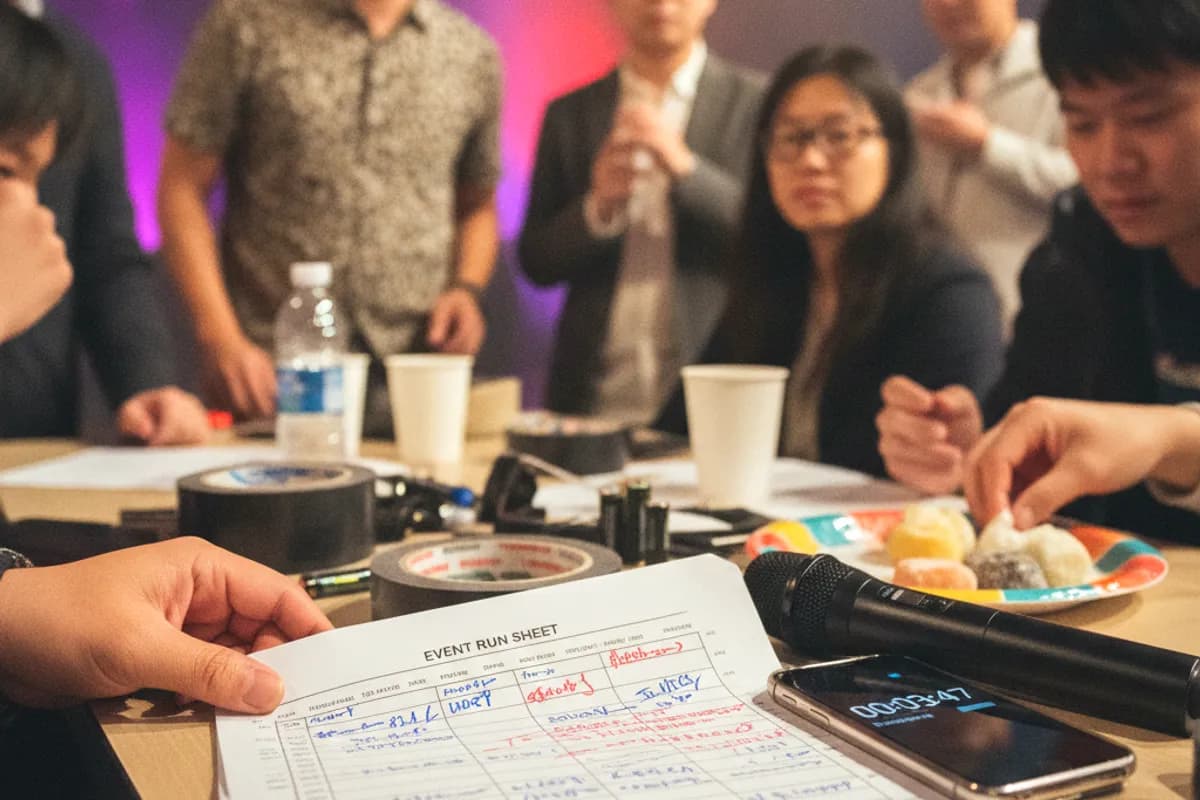
Run sheets
The same programme in a different order is the difference between a room that stays to the end and half the guests leaving at nine thirty. Run-sheet planning is not about what you do — it is about when.
This section holds full timelines for each event type: the lead-in schedule from D-90, and a minute-by-minute rundown for the day.
The numbers come from timing real events — 20 tables of toasts takes about 40 minutes; a winner takes 40–60 seconds to reach the stage in a 150-guest room.
10 guides
First time organising an event? The 15 questions beginners ask most
You've been handed the year-end party, a wedding banquet or a family day with no experience at all — this piece answers the 15 questions beginners ask most, in the shortest form possible, with a link to the detail behind each one.
9 min readSeating Plans: The Top Table, Seating Order, and Who Can't Sit With Whom
The hardest part of a seating plan isn't fitting everyone in — it's the relationships. How to arrange the top table, the principles for corporate events and weddings, the combinations that blow up, and why the organiser shouldn't decide this alone.
8 min readWhat to Do After the Event: Wrapping Up, Reviewing, and the Numbers Worth Keeping
The moment an event ends, most people just want to rest. But what you do over the next three days decides whether next year you work from records — or start guessing from scratch all over again. This piece lists which numbers to capture at wrap-up, how to chase supplier deliverables, and how to run a review that doesn't turn into a blame session.
8 min readHow to Schedule a Year-End Party? A Complete Timetable Template for a 150-Person Event
From setting the tone at D-90 to wrapping up on the day, a year-end party schedule you can use by simply changing the dates. Includes a minute-by-minute rundown, prize draw pacing, and the three most common overrun segments.
11 min readWedding Banquet Day Schedule: Time Allocation from Reception to Farewell
A wedding banquet for 200 guests, packed into three hours with three entrances, a growth video, toasting at 20 tables, and a group photo. This article breaks down how much time to allocate to each segment and highlights the most common delays.
9 min readWhat Differentiates a Spring Banquet from a Year-End Party? Six Key Differences from Guest Composition to Event Flow
Many companies treat a spring banquet as a "delayed year-end party", resulting in external guests sitting ignored in a corner. This article breaks down the practical differences in guest composition, purpose, duration, speech emphasis, and prize draw specifications.
7 min readHow to Organise Outdoor Events? Rain Contingency, Sun Protection, Power, and Flow
Outdoor venues are affordable, spacious, and atmospheric, but the variables are all up in the sky. This article discusses how to design a rain contingency plan, when to make decisions, and the often underestimated items of power and sun protection.
8 min readAttendance Statistics and Table Arrangements: From Registration to Table Plan
"Approximately how many people" is the most costly phrase in event planning. This article covers how to manage registrations, estimate attendance, arrange table plans, and handle last-minute changes.
8 min readCorporate Family Day Planning Guide: Activity Design, Flow and Rain Contingency
A family day is not a scaled-down year-end party. Children, elders, outdoor venues, and queues are four entirely different challenges. This article discusses how to calculate the number of activities, plan the flow, and decide on rain contingency.
8 min readHow to brief event suppliers properly — what a good requirements sheet contains
\"We're planning a year-end party, can you quote us?\" — that sentence gets you a meaningless quote. Here are the fields a requirements sheet needs, what each type of supplier actually cares about, and how to keep three quotes on the same basis.
8 min read