Key points
- A year-end party is for internal reward, while a spring banquet is for external relationship building. The presence of external guests dictates the entire arrangement.
- A spring banquet is typically 30–60 minutes shorter than a year-end party, as toasting and table visits consume time, necessitating a reduction in programme content.
- When external guests are present, the emphasis on speeches and company outlook should increase, while the emphasis on prize draws should decrease.
- External guests must have dedicated reception and farewell arrangements. If this is not organised, all previous efforts will be remembered as "poor hospitality".
Year-end parties and spring banquets are often seen as the same thing—they both take place in banquet halls, feature round tables, and include prize draws. However, if you run a spring banquet like a year-end party, you often end up with the same scenario: external guests sitting in a corner, while the rest of the room engages in inside jokes, ignoring them.
The root of the difference is singular: the composition of guests is different. The other five differences stem from this.
1. Guest Composition
| Year-End Party | Spring Banquet | |
|---|---|---|
| Main Guests | All employees (possibly with family) | Employees + clients/suppliers/partners |
| External Guest Ratio | Almost none | Commonly 15–40% |
| Familiarity | Everyone knows each other | Some may not know anyone at the table |
The presence of external guests changes everything: you cannot assume everyone understands company jokes.
2. Purpose
- Year-End Party: Reward. After a year of hard work, enjoy good food, have fun, win some prizes, and look forward to next year.
- Spring Banquet: Relationship building + New Year declaration. Remind clients of your presence and inform employees of the year's direction.
Different purposes mean different spending priorities. The budget focus for a year-end party is on prizes, while for a spring banquet, it is on meal quality and venue ambiance—as external guests will judge your company's status based on these two factors.
3. Duration and Programme Content
A spring banquet is usually 30–60 minutes shorter than a year-end party.
The reason is toasting and table visits. At events with external guests, managers must toast each table, which takes 25–30 minutes for 12 tables, during which no stage programme can be scheduled (as no one will be watching).
Therefore, the programme for a spring banquet should be reduced:
| Year-End Party (150 people/4 hours) | Spring Banquet (120 people/3.5 hours) | |
|---|---|---|
| Performances | 2–3 acts | 1 act or none |
| Video | 6-minute annual review | 8–10-minute annual outlook/product introduction |
| Prize Draw | Three rounds, 20% win rate | Two rounds, simplified prizes |
| Toasting and Table Visits | Usually none | 25–40 minutes |
| Speeches | 15 minutes | 20–25 minutes |
4. Emphasis on Speeches
The shorter the speeches at a year-end party, the better. The opposite is true for a spring banquet—speeches are one of the key segments.
External guests come, to some extent, to hear what you plan to do this year. This segment should include:
- Last year's achievements (specific numbers, not adjectives)
- This year's direction
- Thanks to clients/partners (mention key clients, this is very effective)
Aim for a length of 10–12 minutes, but schedule 20 minutes in the rundown—allow for overruns.
5. Prize Draw
The prize draw at a spring banquet must address an awkward issue: should external guests participate?
Three approaches:
| Approach | Suitable Situation | Note |
|---|---|---|
| External guests do not participate, instead receive a gift | Low external guest ratio, prize draw is an employee benefit | The gift must be of good quality, given upon departure |
| Separate draw for external guests, with exclusive prizes | Medium to high external guest ratio | Prizes must be more prestigious than those for employees |
| Everyone participates together | Atmosphere-driven, many external guests are familiar | Be prepared to naturally respond if an external guest wins a major prize |
The most common and safest is the first approach: external guests do not participate in the prize draw, but each receives a gift. If the host explains this clearly at the start, no one will feel awkward.
If everyone participates together, the host should prepare a response for when an external guest wins a major prize—this is not a bad thing, but it should be handled naturally.
6. Reception of External Guests
If this is not done well, all previous efforts are wasted.
Arrangements needed:
- Dedicated reception: Assign 1 contact person for every 5–8 external guests, to escort them from registration to their seats.
- Seating: Ensure external guests are not isolated. Either seat them together with a manager at the same table, or distribute them evenly with familiar faces at each table.
- Introductions: When managers visit tables, they should introduce "this is our Manager ○○", not just toast.
- Farewell: Ensure they are escorted to the door. This is the final impression external guests will have of the event.
- Parking and Transport: Prepare parking validations for external guests in advance, do not let clients pay themselves.
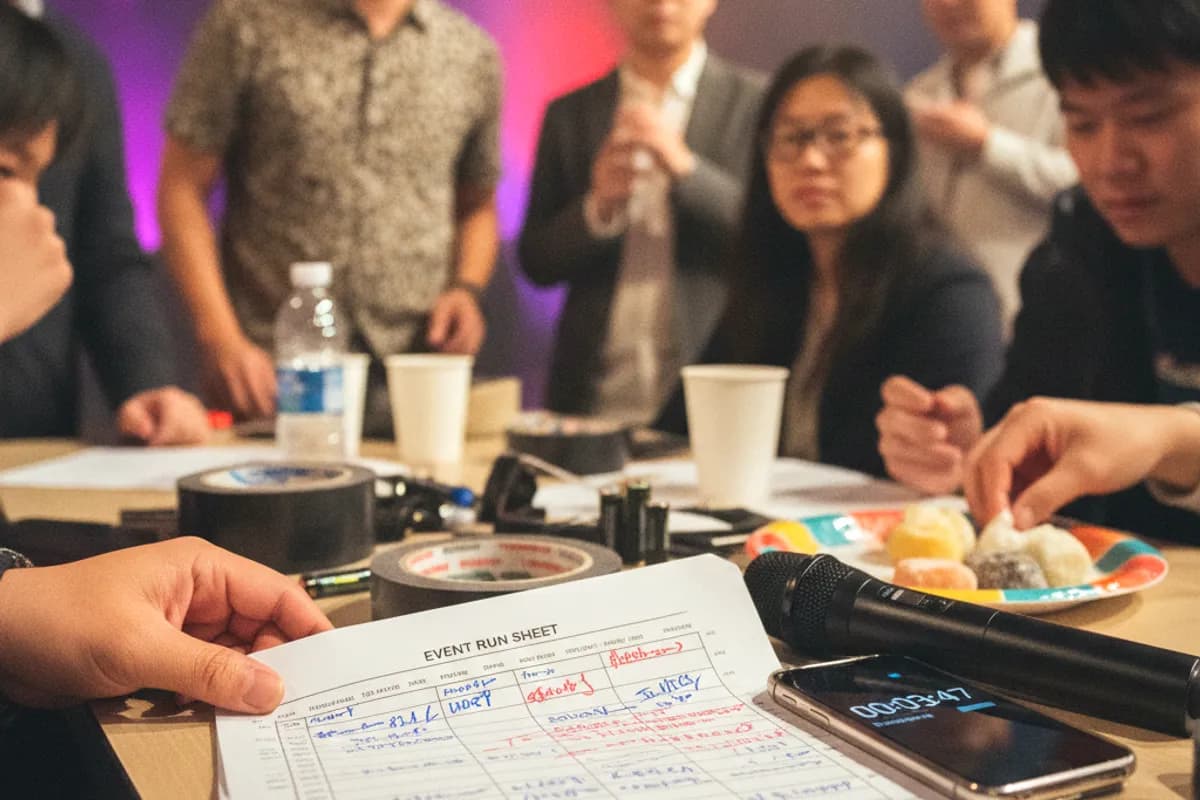
7. Spring Banquet Rundown (120 people/18:00–21:30)
| Time | Item | Minutes | Notes |
|---|---|---|---|
| 15:30 | Entry, Setup | 60 | |
| 16:30 | Equipment Testing and Run-through | 45 | |
| 17:30 | Registration Area Ready, Welcome Music | 30 | External guest reception staff also in place |
| 18:00 | Entry, Registration, Welcome Photos | 30 | External guests escorted to seats |
| 18:30 | Opening: Host + Manager's New Year Speech | 15 | Schedule 20 minutes as buffer |
| 18:45 | Start Meal; Toasting and Table Visits Begin | 40 | No stage programme during this time |
| 19:25 | First Prize Draw (Small Prizes) | 12 | |
| 19:40 | Annual Outlook/Product Introduction | 10 | Key segment when external guests are present |
| 19:55 | Full Interaction | 18 | Particularly effective when mixing internal and external guests |
| 20:15 | Performance Programme | 12 | Only one act scheduled |
| 20:30 | Second Prize Draw + Major Prizes | 25 | |
| 21:00 | Group Photo | 10 | |
| 21:15 | Conclusion, Farewell | 15 | External guests should be escorted to the door |
8. Icebreaker: Ensuring Internal and External Guests Actually Converse
The biggest waste at a spring banquet is spending money to invite clients, only for there to be no interaction all evening.
Toasting does not solve this issue—toasting involves managers moving around, while clients remain seated. What is effective is a segment involving everyone, scheduled after toasting (the 19:55 segment):
- Company trivia quiz (questions should be answerable by external guests, such as industry knowledge rather than internal jokes)
- Games requiring table cooperation
- A group photo with everyone
15–20 minutes is sufficient. The key is giving people at the table a reason to speak.
Golden rule for question design: Do not ask questions only insiders would know. Questions like "What is the nickname of our finance department's Ms. Wang?" will make external guests feel even more like outsiders.
Quick Reference
| Item | Year-End Party | Spring Banquet |
|---|---|---|
| Purpose | Reward employees | Relationship building + New Year declaration |
| Budget Focus | Prizes | Meal quality and venue ambiance |
| Total Duration | 4 hours | 3–3.5 hours |
| Speeches | 15 minutes, the shorter the better | 20–25 minutes, a key segment |
| Performances | 2–3 acts | 0–1 act |
| Toasting and Table Visits | Usually none | 25–40 minutes, must schedule |
| Prize Draw | Three rounds, 20% win rate | Two rounds, separate gifts for external guests |
| Special Focus | Prize draw rhythm | Reception and farewell for external guests |
→ Get the Spring Banquet Flow Template → Complete Year-End Party Rundown → How to Write an MC Script
Figures come from events we delivered and public sources. Actual terms vary by venue and date — always confirm with the venue.