Key points
- Write the numbers down within three days. A week later, nobody remembers when check-in peaked or which segment ran over.
- The single most valuable number is registered vs. actual attendance — that is your company's real turnout rate, so you never have to guess table counts again.
- Supplier deliverables need a tracking sheet. Photography, video and highlight edits all have different due dates; without chasing, they drag out to three months.
- Keep the review about the process: ask "which segment did we time wrong?", not "who let the speech run over?".
On the night an event ends, nobody wants to do the wrap-up. That's normal.
The problem is this: you'll run it again next year, and when you do, you'll find yourself guessing at the same questions all over again — roughly how many people will show up? How many check-in lines do we need? How long to allow for the toasting round? Every one of those answers already happened last time. Nobody wrote them down.
Wrapping up isn't a formality. It's turning this event's experience into next year's starting point.
1. Within three days: while the memory is still warm
Some information is simply gone after a week. Do these first:
| When | What to do | Why it can't wait |
|---|---|---|
| The night itself | Count leftover prizes, confirm the list of unclaimed ones | Someone will ask about it tomorrow |
| D+1 | Record actual headcount, check-in peak window, any overrun | On-site staff still remember |
| D+1 | Collect staff impressions while they're fresh (message them, don't call a meeting) | A few days later you'll only get polite noises |
| D+2 | Confirm venue and supplier costs, and any extra charges | Reconcile early — disputes are easier to settle |
| D+3 | Do a first pass on photos, check whether anything was missed | Still time to go back to the photographer |
Collect staff impressions by message. What you get in a meeting is the polished answer; drop a line right after the event asking "what felt most stuck to you today?" and what comes back is the truth.
2. The numbers worth keeping
This is the most valuable part of the wrap-up. Every item below feeds directly into your next decision:
| Number | How you use it next time |
|---|---|
| Registered vs. actual attendance | Gives you your company's real turnout rate — no more guessing at table counts |
| Proportion bringing partners, number and ages of children | Decides whether you need children's meals and high chairs |
| Actual vegetarian and allergy meal counts | Carry the same ratio over next time |
| Which 10 minutes were the check-in peak | Sets the number of check-in lines and when staff need to be in place |
| Actual start and end times of each segment | Corrects the rundown, especially speeches and the toasting round |
| Whether you ran over, and by how long | Sets your buffer next time, or gives you grounds to negotiate free overrun with the venue |
| Budget: estimated vs. actual (by line item) | Shows you which item you always underestimate |
| Prizes: win rate, which prizes got the biggest reaction | Adjusts the prize structure |
| Number of unclaimed prizes | Decides whether the "must be present" rule needs changing |
The first one is the most valuable. The turnout rate we give in Attendance Tracking and Table Planning is an industry range (corporate events run at roughly 85–95% of registrations), but your own company's number will always beat the range. Track it for two years and you have a reliable baseline.
How to record actual segment times
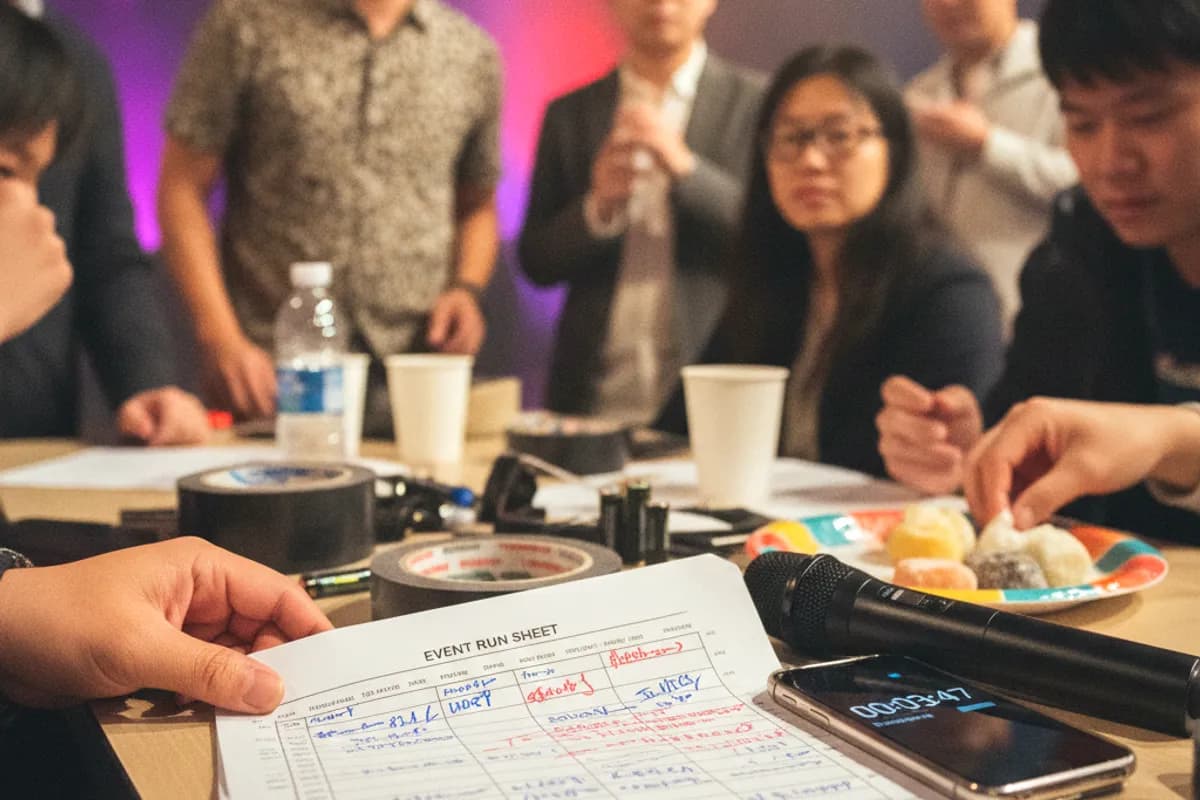
On the day, assign someone to hold the rundown and write down the real time at the start of each segment. It doesn't need to be accurate to the second — to the minute is enough.
Compare afterwards and the pattern shows up fast: usually the speeches always run over, the toasting round is always underestimated, and the time it takes prize winners to get on stage was never counted at all.
3. Tracking supplier deliverables
Deliverables are the easiest thing to let slip after an event. Open a sheet and track them:
| Supplier | Item | Agreed due date | Actually delivered | Status |
|---|---|---|---|---|
| Photography | 200 selected, retouched images | D+14 | ||
| Video | 3-minute highlight edit | D+30 | ||
| Video | Raw footage backup | D+30 | ||
| Venue | Official invoice | D+7 | ||
| Prizes | Large prizes delivered to recipients | D+7 |
If the date passes and nothing has arrived, ask. Photography and video deliverables dragging out to two or three months is common, and it's usually not that the supplier won't do it — it's that nobody chased.
Confirm two more things at the same time:
- Where the files live and how long they last: cloud links often expire, so download a copy into your company's own storage as soon as you receive them.
- Licence scope: can you use the material on your website, on social, in recruitment material? Is there a time limit? What the contract says and what you assume it says may differ.
4. Settling the costs
| Item | What to check |
|---|---|
| Venue | Actual table count, overrun fees, add-ons, how the service charge is calculated |
| Catering | Extra dishes, drinks, corkage |
| Suppliers | Overtime charges, items added at the last minute |
| Prizes | What happens to unused prizes (return them? hold them for next year?) |
| Contingency | What you actually spent, and how far that is from the estimate |
Check line by line, not just the total. The most common disputes are overrun fees and add-ons — things agreed verbally on the day turn into charges on the invoice. The written confirmation you kept from the site visit is your evidence at exactly this point.
Prize tax should be dealt with now: any single prize above the market-value threshold requires a withholding statement, and the winner's signature and identity details should have been collected on the day itself. Check the specifics with your company's accountant.
5. How to run the review
There's an easy trap with review meetings: they turn into blame sessions. Once someone is named, nobody will say anything honest again, and the meeting was wasted.
Ask the right questions
| Don't ask | Ask instead |
|---|---|
| Who let the speech run over? | How many minutes did we allow for the speech? How long did it actually take? How many should we allow next time? |
| How did check-in get that backed up? | When was the check-in peak? How many lines were open? How many should have been? |
| Why did the video have no sound? | When did we test it? Did we test with the actual file? |
| Who was responsible for the prizes? | Which step of the prize process had nobody covering it? |
The difference: the left column looks for a person, the right column looks for the gap in the process. Close the gap and it won't happen again, whoever is doing the job.
Meeting structure (40 minutes is enough)
| Section | Minutes | Content |
|---|---|---|
| Numbers review | 10 | Turnout rate, budget actual vs. estimate, timings compared |
| What went well | 5 | Say it explicitly — this is what you keep next time |
| What got stuck | 15 | For each item, ask "where did the process not connect?" |
| Changes for next time | 10 | Keep only 3–5, each with a named owner |
Keep only 3–5 changes for next time. List 20 and none of them will happen. Pick the few with the biggest impact and write them into next year's rundown template.
6. The one-page wrap-up report
The version for your boss doesn't need to be long. One page with this much is enough:
【2026 Year-End Party — Wrap-Up Report】

■ Basics
Date: Sat 17 Jan 2026, 18:00–22:15 (15 minutes over)
Venue: ○○ Hotel, third-floor banquet hall
Registered 210 / actual 193 (turnout rate 92%)
Actual 20 tables (20 booked)

■ Budget
Estimated 500,000 / actual 517,400 (+3.5%)
Main causes of overspend: overrun fee 12,000, table added on the day 8,000

■ On the day
Check-in peak 18:20–18:30 (3 lines open, enough)
Interactive game participation 168 people (87%)
Prize draw win rate 20% (30 winners)
Unclaimed prizes 2 (winners notified)

■ Three things to change next time
1. Allow 10 minutes for the speech (allowed 5 this year, ran 14)
2. Split the toasting round into two simultaneous routes (20 tables took 42 minutes this year)
3. Hand out vouchers on site for large prizes and deliver afterwards

■ Outstanding
Photography due D+14 / video due D+30 (being tracked)
"Three things to change next time" is the most important part of the whole report. Everything else is a record; only those three lines change next year.
7. Put the record somewhere findable next year
The most common failure is this: the wrap-up report gets written, and next year nobody can find it.
- Store it in shared storage, not on the organiser's own computer.
- Put the year and event type in the filename (
2026_year-end-party_wrap-up-report). - Write the "things to change next time" straight into the rundown template, not only into the report — next year's organiser will open the template, and may never open the report.
Checklist
Within three days
- Leftover prizes counted, list of unclaimed prizes made
- Actual headcount, check-in peak and any overrun recorded
- Staff impressions collected by message
- Venue and supplier costs provisionally confirmed
- First pass on photos done, nothing missed
Within two weeks
- All nine key numbers compiled (turnout rate, vegetarian ratio, actual segment times…)
- Supplier deliverable tracking sheet created
- Costs checked line by line
- Prize tax handled
- Review meeting held, 3–5 improvements agreed
Closing out
- All deliverables received and backed up locally
- Licence scope confirmed
- Wrap-up report stored in shared storage, filename includes the year
- "Things to change next time" written into the rundown template
→ Attendance Tracking and Table Planning → Year-End Party Rundown Template → Get rundown templates you can use as-is
Figures come from events we delivered and public sources. Actual terms vary by venue and date — always confirm with the venue.