Key points
- Order matters more than effort: fix the date, headcount and budget ceiling first, then look at venues, and only then think about the programme. Do it backwards and you will start over.
- The three things most often underestimated: load-in time, speech length, and how long it takes people to walk up on stage.
- Registrations are not attendance. At corporate events, roughly 85%–95% of those who sign up actually turn up.
- When in doubt, ask the venue's sales rep. They see hundreds of events a year and have already met every problem you're worried about.
You've been handed an event, and it's your first.
This piece gathers the questions beginners ask most and answers them in one place. Each one is a short answer plus the number that matters; click through if you need the detail. If you'd rather see the full timeline, there's a separate piece: "Running an event, start to finish".
Before you start
1. How far ahead should I start preparing?
For 150 people, allow three months (D-90). Venues in peak season need longer — the good dates in year-end party season (December to February) and in wedding banquet season start going six months out.
The real deadline is the venue. Everything else can be compressed; if you can't book a venue, your only option is to change the date.
2. What's the first step?
Fix three things: the date, a headcount range, and a budget ceiling.
Until those three are set, every later step will have to be redone. Note that it's a headcount range, not an exact number — knowing the upper and lower bounds is enough to start looking at venues.
3. Book the venue first, or confirm the headcount first?
Get a headcount range first, then book the venue.
Venues have minimum table counts. Book a hall with a 20-table minimum when you only have 12 tables and you'll pay for the empty ones.
But the number doesn't need to be exact — use a guaranteed table count to set the floor when booking, and most venues allow adjustments 3–7 days before the event.
Budget
4. Roughly how much will it cost?
Work backwards from the per-table price. Catering is usually 55%–70% of the total budget.
150 people is about 15 tables; at NT$18,000 per table:
18,000 × 15 × 1.1 (service charge) = 297,000
297,000 ÷ 0.6 ≈ NT$500,000 total budget
→ How to size an event budget: category shares and price bands
5. What does the per-table price include? Is service charge extra?
Always ask whether the quoted price includes service charge and tax. Service charge is usually 10% — across 15 tables that's a difference of more than NT$40,000.
When comparing quotes, convert all three to a service-charge-inclusive total before comparing, or you aren't comparing the same thing.
→ Negotiating with a banquet venue: where the room actually is
6. Is the price negotiable?
There's very little room on the per-table price (usually within 5%), but far more on everything else: whether service charge is included, load-in time, corkage, add-on decoration, parking validation.
Your biggest lever is flexibility on the date. The same hall can differ by 30% between a weekday lunch and a Saturday evening.
Venues
7. Hotel, wedding banquet venue, or a restaurant buyout?
It depends on the number of tables:
| Tables | Usually choose |
|---|---|
| Under 20 | Restaurant buyout (though most have no stage or projection) |
| 20–50 | Wedding banquet venue |
| Over 50 | Hotel |
→ How to choose between the three venue types
8. How many tables do I book for how many people?
Ten people per table, but you can't just divide. Apply an attendance rate to the registration count first.
At corporate events, actual attendance is about 85%–95% of registrations:
210 registered × 0.92 ≈ 193 people ÷ 10 ≈ book 20 tables
→ Attendance numbers and table planning
9. What should I ask on a site visit?
The four that matter most:
- Load-in time — an hour is not enough for any large-scale set-up, and it needs to be written into the contract
- Whether the projection is visible with the lights up — bring your own laptop and test it; don't go by the spec sheet
- The minimum table count and how empty-table charges are calculated
- The overtime rate
→ Site visit checklist: 20 things you have to test in person
10. Can I change the date after paying the deposit?
Deposits are almost never refundable, but date changes are usually negotiable — and you need to negotiate them when you sign.
Put this in the contract: how many changes are allowed, how much notice is required, the administrative fee, and whether the original price still applies if you move to a peak-season date. That last one is where people get caught out.
On the day
11. How do I build the run sheet?
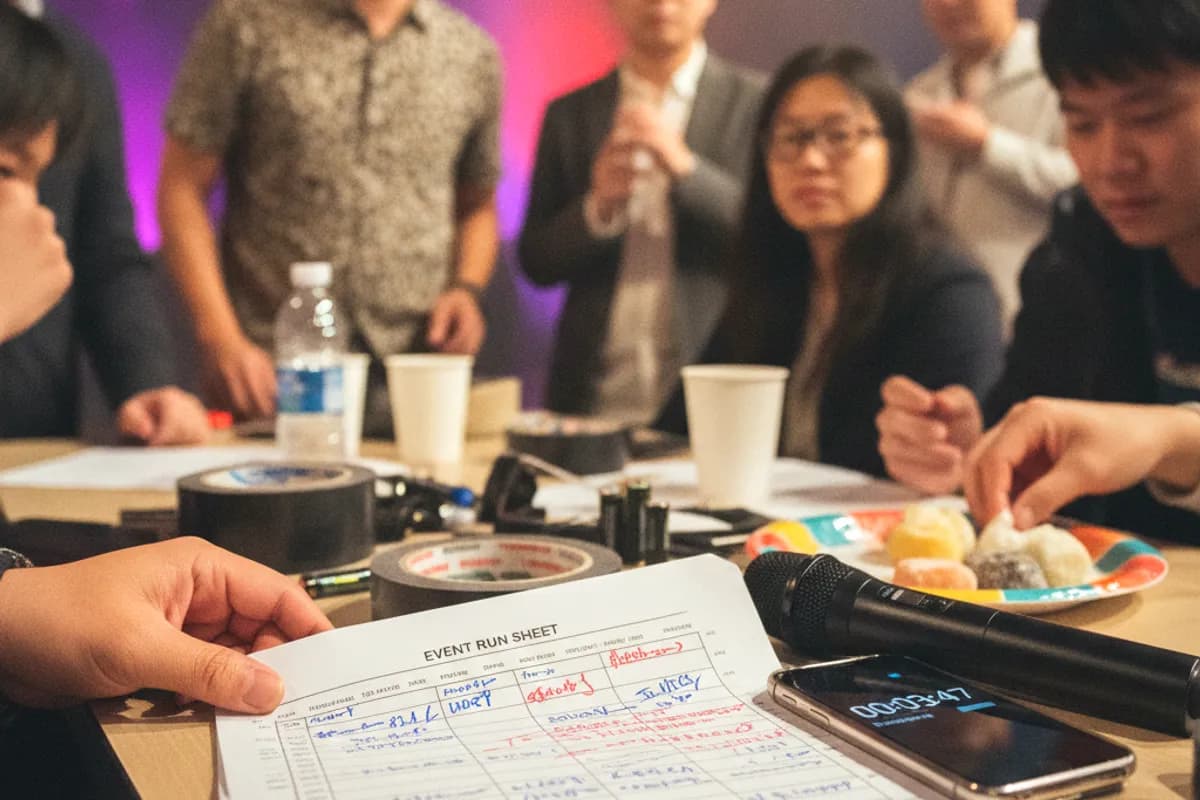
Take an existing one and edit it. There are templates for year-end parties, spring banquets, wedding banquets and family days, each with a lead-up schedule and a minute-by-minute rundown — swap in your date and headcount and it's ready to use.
The three most commonly underestimated:
| Segment | Common mistake | What to actually allow |
|---|---|---|
| Speeches | Scheduling 5 minutes | 10 minutes |
| Toasting rounds (20 tables) | Scheduling 20 minutes | 40 minutes |
| Winners coming up on stage | Not counted at all | 40–60 seconds per person |
12. Do I have to have performances?
Not necessarily. But you need one segment mid-event that the whole room takes part in, or the energy drops after 8:30pm.
Options: departmental performances, a year-in-review video, a room-wide interactive game, a lucky draw. Don't put the whole lucky draw at the end — split it into three rounds spread through the evening, and people will stay to the finish.
→ Designing a lucky draw that doesn't kill the room
13. How many prizes should I draw, and how much should they cost?
- Prize budget: 10%–15% of the total budget
- Aim for a 20% win rate (25–35 slots for 150 people), so the room feels it has a chance
- Few big prizes, many mid-size and small ones — cash and vouchers are always the most popular
Individual prizes above a certain market value trigger withholding tax; check with your company's accountant first.
14. Do I need an MC? Can I do it myself?
You can do it yourself, but you need a script. An MC's core value isn't humour, it's timekeeping.
If you're doing it yourself, prepare at minimum: a 90-second opening script, a handover line for each segment, and three ways to cover the unexpected (the winner isn't in the room, a speech overruns, the next segment isn't ready).
15. Will check-in back up?
Yes. Half your guests will arrive in the last 10 minutes.
Lane count: headcount ÷ (check-in minutes × 3), calculated against the peak. For 150 people over 30 minutes, run at least 2 lanes; 3 to be safe.
→ Check-in and guest flow design
The five mistakes beginners make most
| Mistake | Consequence | How to avoid it |
|---|---|---|
| Planning the programme before finding a venue | The venue can't accommodate it | Fix the date, headcount and budget first |
| Trusting verbal promises | A change of floor manager and it no longer counts | Send a written confirmation message after every site visit |
| Never testing the video on site | No sound on the day, or the aspect ratio is wrong | Test with the actual venue, the actual laptop, the actual file |
| Putting the whole lucky draw at the end | People leave as soon as it's over | Split it into three rounds spread through the evening |
| Leaving no contingency budget | No money for overtime charges or a last-minute extra table | Set aside 5%–8% of the total budget |
Still not sure what to do
Ask the venue's sales rep. They see hundreds of events a year, and every problem you're worried about is one they've already met. Ask them directly: "For an event our size, how do people usually arrange this?" Most reps will give you a genuinely useful answer, because a smooth event is good for them too.
You can also write your requirements up once and send them to three suppliers for quotes; there's a template you can copy straight out of "How to brief a supplier properly".
The minimum checklist for a first-time organiser
- Date, headcount range and budget ceiling are set
- Three venues visited, all four key questions asked
- Load-in time is written into the contract
- Date-change terms agreed before signing
- Quotes converted to service-charge-inclusive totals before comparing
- Attendance rate factored into the table count
- Run sheet adapted from a template, with double the time allowed for speeches and toasting
- Video tested on site
- Lucky draw split into three rounds
- Check-in lanes calculated against the peak
- 5%–8% contingency budget set aside
- Actual attendance recorded after the event (so next time you're not guessing)
→ Running an event, start to finish (the full timeline) → Get run sheet templates you can use as they are → Browse the nationwide banquet venue database
Figures come from events we delivered and public sources. Actual terms vary by venue and date — always confirm with the venue.